New Zealand Property Market Report: Regional Variations Entrench as Winter Market Steadies (June 2026)
The New Zealand housing market maintained a steady footing through June 2026. While nationwide conditions remain cautious due to seasonal winter factors and economic influences, distinct regional differences have become firmly entrenched.
According to the latest data from the Real Estate Institute of New Zealand (REINZ), the national property market has effectively become a collection of localized markets operating at entirely different speeds.
New Zealand Property Market Snapshot (June 2026)
A quick look at the core nationwide real estate metrics for the month shows a balanced environment for buyers and sellers alike:
National Median House Price: $770,000 (Up +0.7% year-on-year).
National Sales Volume: 5,996 properties sold (Down -2.9% year-on-year).
National House Price Index (HPI): 3,553 (Down -0.8% year-on-year).
Median Days to Sell: 48 days (1 day faster than June 2025).
National Overview & Key Market Influences
The national median house price held firm year-on-year at $770,000. When adjusting for typical winter seasonality, sales activity shifted very little from May, pointing to a stabilizing base. Out of 35 years of historical June records tracked by REINZ since 1992, the June 2026 sales volume ranked 23rd, keeping it comfortably above historical lows.
Several economic and political factors dictated buyer and seller sentiment throughout the month:
Interest Rates & OCR: Anticipation surrounding a potential July Official Cash Rate (OCR) increase saw some buyers accelerate their purchase timelines, while others took a more deliberate approach. With interest rate trajectories largely priced in by banks, mortgage rates remained steady.
Cost of Living: Sustained domestic living costs and fuel prices remaining above pre-conflict baselines continued to keep affordability front of mind.
Political Landscape: The approaching general election in November prompted a common "wait and see" pattern among investors and buyers nationwide.
Regional Breakdown: Winners and Steady Performers
Six of New Zealand's 16 regions experienced positive year-on-year median price growth, led predominantly by sustained momentum in the South Island.
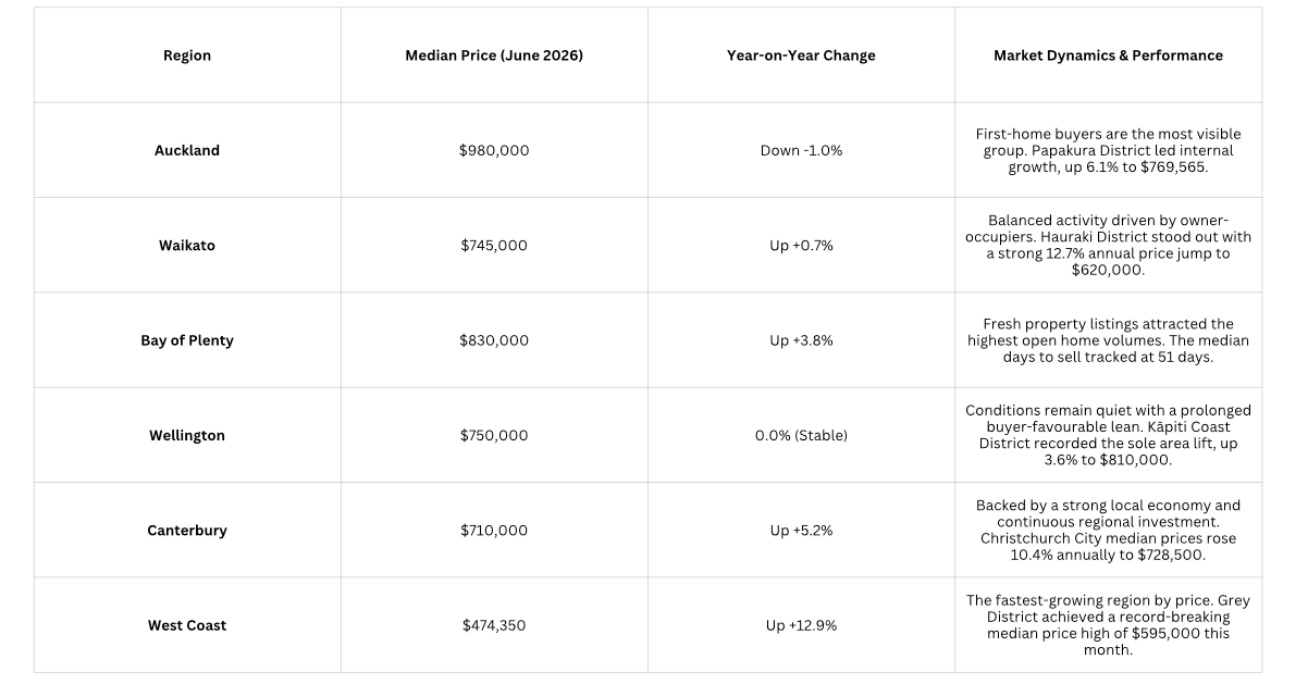
Notable HPI Strengths: While the raw national price trend softened slightly, local indices highlight targeted capital growth. Southland recorded the strongest annual House Price Index (HPI) growth at +8.6%, followed closely by Otago (+4.3%) and Canterbury (+4.1%).
Smart Market Navigation with HouGardenWith the New Zealand real estate market fracturing into highly distinct local micro-markets, generic property advice no longer applies. What is true for a buyer in Canterbury—where stock is moving quickly—is vastly different from the conditions facing a buyer navigating Auckland’s extensive inventory or Wellington's extended days to sell.
To successfully spot undervalued opportunities or properly time your next listing, utilizing tailored local search tools is essential. HouGarden provides comprehensive, real-time property listings, historical sales data, and region-specific market insights designed to help buyers, investors, and vendors make data-driven real estate decisions. Whether you are tracking first-home buyer options in Auckland or looking for high-yield properties in the South Island, HouGarden maps out local trends directly in your neighborhood.
Market Outlook
Real estate indicators point to a continuation of these stable, winter-level patterns over the immediate short term. As community confidence solidifies, inflation pressures level out, and clarity emerges post-election, local sales professionals widely expect transaction volumes and property stock levels to gradually scale up going into the spring cycle.
Credits & Data Sources
Statistical Data Source: Real Estate Institute of New Zealand (REINZ) Monthly Property Report (Published 15 July 2026).